TeslaFi, Teslascope and MyTeslaCloud: closed clouds vs. open hosting
TeslaFi has run since 2016; Teslascope has a free tier. Both are real products. The difference is not "who has more features" but whether the dashboard is fixed and whether the data is yours.
- TeslaFi and Teslascope are closed-source clouds with fixed dashboards; MyTeslaCloud runs Grafana, which you can drill into without limits.
- TeslaFi’s real strength is fine-grained sleep and polling control. Teslascope’s is price — it has a genuinely free tier.
- Since Tesla moved to pay-per-use API pricing in late 2024, each vendor absorbed it differently — TeslaFi’s standard plan has sat around 500 commands and 25 wakes per month.
- The substantive difference is whether you can take the data out whole: MyTeslaCloud gives you a private PostgreSQL instance that runs in self-hosted TeslaMate.
- At $39.99/year MyTeslaCloud sits near Teslascope Plus on price, while keeping the open-source foundation.
Besides Tessie, the two names that come up most often are TeslaFi and Teslascope. The first has been running since 2016 and is known for fine-grained sleep and polling control; the second competes on price and keeps a free tier. Both are legitimate products, and this article is not out to knock them — just to be specific about where they differ.
How the three are positioned
| TeslaFi | Teslascope | MyTeslaCloud | |
|---|---|---|---|
| Type | Closed-source cloud | Closed-source cloud | Managed open-source TeslaMate |
| Dashboards | Built-in web UI | Built-in web UI | Grafana, fully drillable |
| Free tier | No (trial) | Yes — Community | No (14-day terms apply) |
| Polling control | Fine-grained, its strength | Basic | TeslaMate’s strategy |
| Data ownership | Their servers | Their servers | Your private database |
| Data export | Limited | Limited | Full database export |
| Price | ~$7.99/month | $3.99 / $6.99 per vehicle | $4.99/mo · $39.99/year |
Third-party pricing is public information as of July 2026 (TeslaFi around $7.99/month; Teslascope free Community tier plus Plus $3.99 and Pro $6.99 per vehicle per month). Check teslafi.com and teslascope.com for current rates. MyTeslaCloud is built on the open-source TeslaMate project.
Difference one: fixed dashboards vs. drillable ones
TeslaFi and Teslascope both use their own web interfaces. Both are mature and well organised, but the dimensions you can look at are the ones the vendor built. Want a different cut — this year only, highway trips only, one particular charger, aggregated by week? Whether you can depends on whether they shipped that filter.
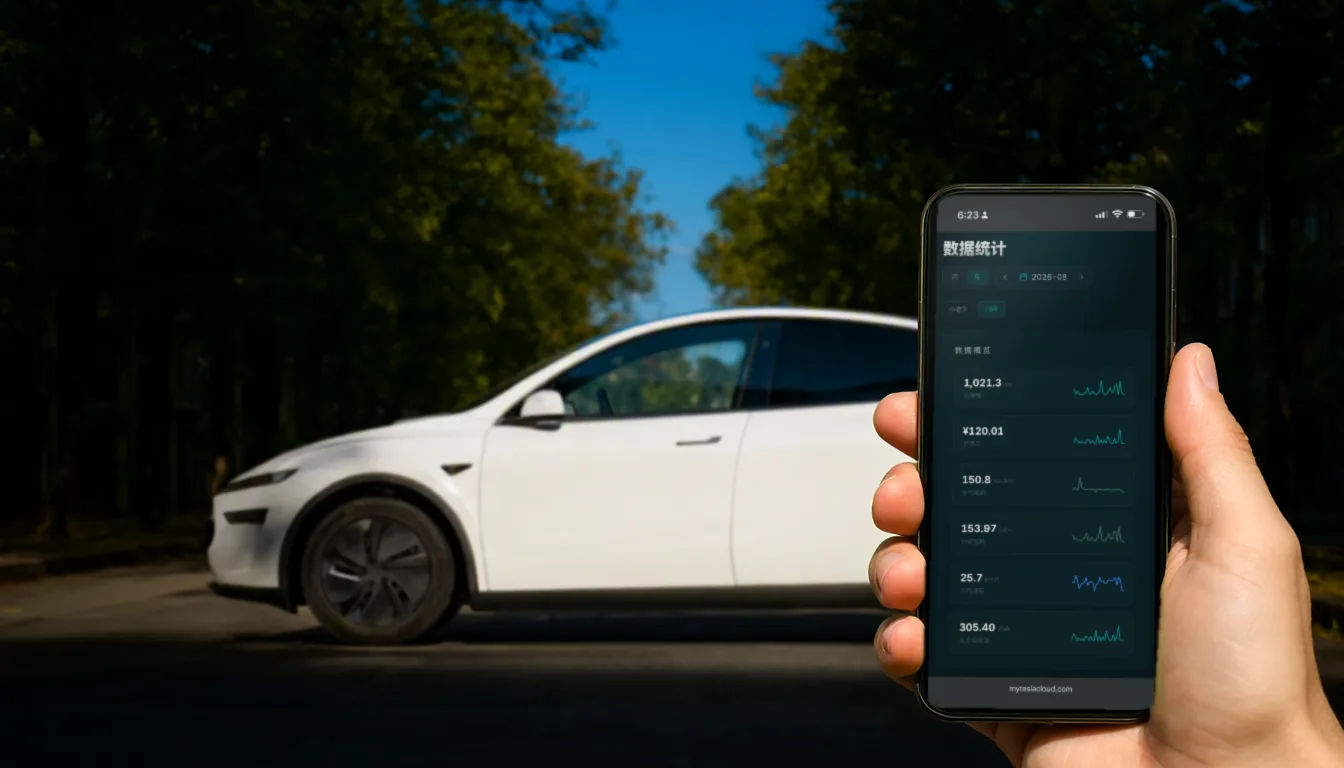
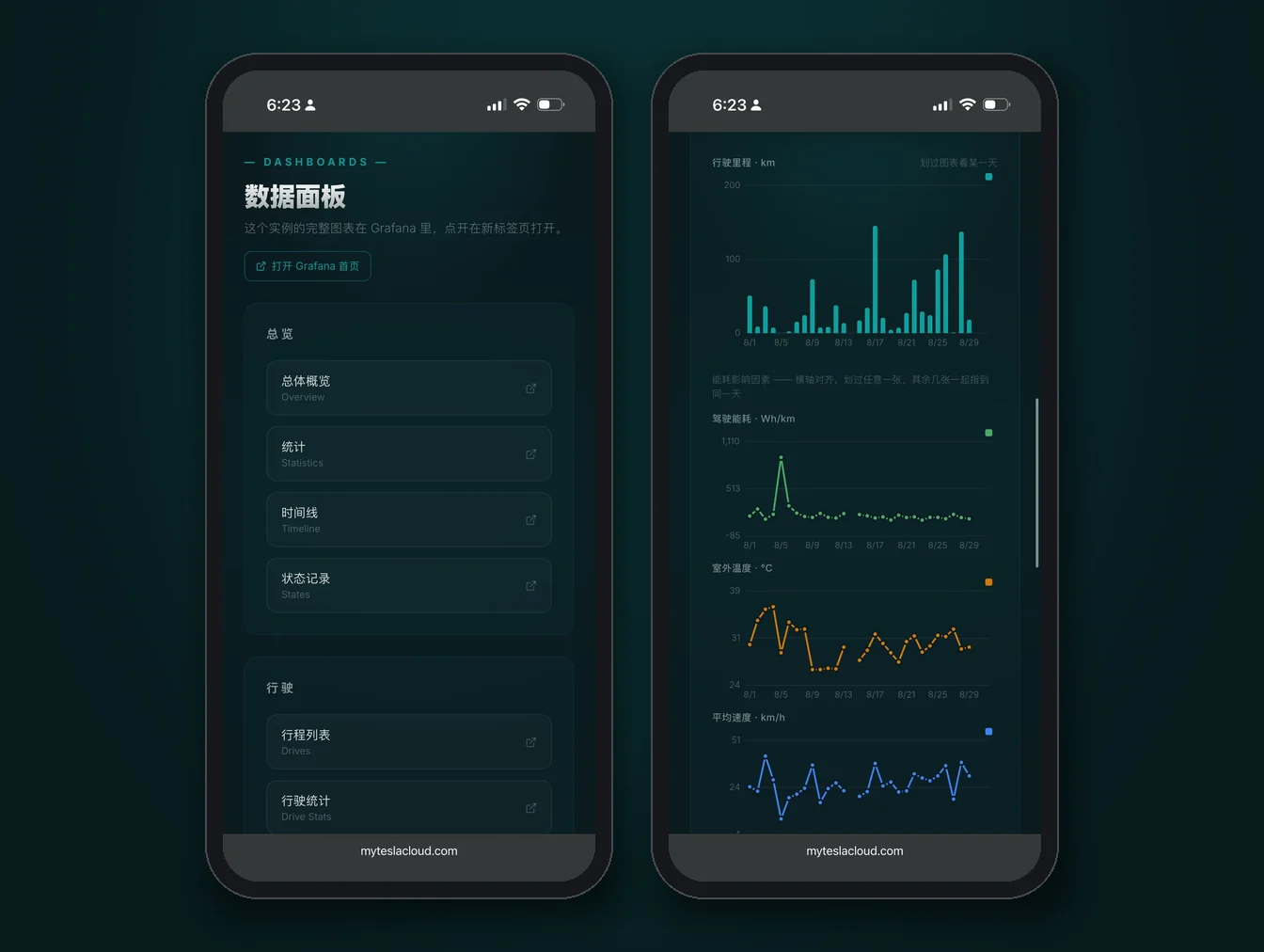
MyTeslaCloud runs Grafana underneath. Same data, but you change the time range, add filters, switch chart types, or build panels of your own. The cost is that it looks less tidy than a finished product out of the box; the benefit is that there is almost no ceiling. We also ship a lighter modern UI panel for everyday viewing, so you only drop into Grafana when you are actually digging.
Difference two: API limits
In late 2024 Tesla moved its API to pay-per-use pricing — every data read and every command now costs the operator money. Every logger had to absorb that somehow. Some raised prices and capped monthly usage (TeslaFi’s standard subscription has sat around 500 commands and 25 wakes per month); others moved to per-vehicle billing.
For most owners who simply want logging, these caps never bind — they mostly constrain heavy automation users. But if you plan to fire a lot of remote commands, read the limit terms carefully before you subscribe anywhere.
Difference three: owned vs. borrowed data
This is the substantive one. In a closed service, your history lives in the vendor’s product shape: visible, but hard to take out whole and impossible to point at your own systems. MyTeslaCloud gives you a private PostgreSQL instance; on request you can export the whole thing, and the export runs in a self-hosted TeslaMate without translation.
For multi-year curves like battery degradation this matters more than it sounds. The value is entirely in the continuity — once there is a gap, nothing fills it back in.
Difference four: what if the service shuts down
Nobody enjoys thinking about this, but it is worth one paragraph. Third-party Tesla tooling is a small business and services have closed before. If the one you use shuts down:
- A closed cloud service — you typically get a limited export file, and there is nowhere else that can run it. Several years of records effectively stop there;
- MyTeslaCloud — the data is standard PostgreSQL, so it imports into a TeslaMate you host yourself and the curve keeps going;
- Self-hosted TeslaMate — it was always yours; as long as the upstream project exists, the question does not arise.
So choosing an open foundation is not only about flexibility today. It buys you an exit path — one you will probably never use, and which has no substitute on the day you need it.
What to check before subscribing anywhere
These questions are vendor-neutral, and every one of them matters a year in. Spend five minutes on the vendor’s own site before you pay:
- How is API usage counted? Is there a monthly cap, and what happens when you hit it — service stops, polling slows, or you top up?
- Can you export everything? In what format — a usable database, or a summary sheet?
- Per vehicle or per account? For multi-car households this single line decides the total.
- Is your account region supported? Mainland-China accounts authenticate separately and support varies.
- How long is data kept after you cancel? Deleted immediately, held 30 days, or kept indefinitely?
MyTeslaCloud’s answers: usage is topped up rather than hard-capped, full PostgreSQL export on request, billed per vehicle, both global and China regions supported, and data deleted 30 days after expiry (with email reminders at 7, 3 and 1 days before). For the others, check their own sites — which is what the links above are for.
Which to pick
If fine-grained polling and sleep control are your priority and you like a mature, self-contained product, TeslaFi is a seasoned choice. If price comes first or you want a free tier to test the water, Teslascope has the lowest barrier — and at $3.99/month it is genuinely inexpensive.
If you want a data layer you can drill into without limits, export in full, and keep running elsewhere if you ever leave, MyTeslaCloud is the one built for that — at $39.99/year, roughly in the same bracket as Teslascope Plus while giving you the open-source foundation.
Third-party features and pricing verified September 2026 and subject to each vendor’s own site. MyTeslaCloud is not affiliated with Tesla, Inc. or with any service named here.